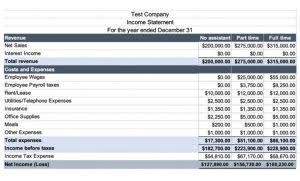
In essence, bookkeepers and accountants collaboratively contribute to the comprehensive financial landscape of a business. The cash flow statement is important because the income statement and balance sheet are normally prepared using the accrual method of accounting. Hence the revenues reported on the income statement were earned but the company may not have received the money from its customers. While there are certain similarities and overlaps between the two, there are distinctions that set these two roles apart. Broadly speaking, bookkeepers document financial transactions and maintain records. Accountants analyze and interpret financial data to create financial statements, assist with planning, and provide insight into a company’s financial retained earnings standing.
Job opportunities and salaries
- A bookkeeper will complete these steps and use the chart of accounts to post every journal entry and financial transaction within the general ledger.
- You can find a CPA through directories hosted by your state’s accountancy board.
- Both roles are vital yet distinct—the former is more transactional, while the latter is inherently analytical.
- Accountants handle complex tasks such as tax return preparation, financial analysis, and business audits.
- Liabilities also include amounts received in advance for a future sale or for a future service to be performed.
- Under the accrual method of accounting, a business is to report all of the revenues (and related receivables) that it has earned during an accounting period.
- According to Forbes, 66% of business owners use professional bookkeeping services to manage their financial operations because bookkeeping is the foundation for effective financial management.
An accountant has a higher skill set than a bookkeeper, whose primary responsibility is handling the actual recording of the company’s financial transactions. Bookkeepers manage the general ledger for organizations, recording financial transactions so that companies can manage their finances. They create financial reports for managers to track payments, process payroll, and prepare invoices. That part of the accounting system which contains the balance sheet and income statement accounts used for recording transactions. With over 22 years of global expertise and 5000+ skilled professionals, Flatworld Solutions is a leading provider of professional bookkeeping and accounting services.
- Accountants also conduct audits and provide tax strategy and compliance services.
- This costs approximately $8.65 per month, $85 per year, or $540 for life.
- And bookkeeping is an ideal subject to learn online, because the course material is well suited for a virtual learning environment.
- Bookkeeping focuses on generating detailed financial records and routine operational reports.
- In fact, QuickBooks Advanced continuously saves your records in the background, so you can restore data to a specific point if needed.
- Bookkeeping records daily financial transactions; accounting analyzes and interprets this data.
Frequently Asked Questions About Bookkeeping Certificates
A trusted partner like NorthStar Bookkeeping ensures these functions align to give you a clear picture of your financial health. When choosing accounting software, consider your budget and business accounting needs. Many accounting programs have free versions that cover the Liability Accounts basics, such as tracking income or generating financial reports. Trying a free solution can help you test an accounting platform and determine if an investment in a full-featured version is worthwhile. This platform offers most of its services for free and allows unlimited users to collaborate on financial projects. Every business step requires capital, from transforming an idea into a model to investing in its expansion.

General Ledger Accounts
- As we had discussed earlier, revenues cause stockholders’ equity to increase while expenses cause stockholders’ equity to decrease.
- On the other hand, hiring a professional bookkeeper saves you time and reduces stress, especially when your books get complex.
- Understanding the difference between bookkeeping and accounting is essential for managing your business’s financial health effectively.
- The bookkeeper tends to be very experienced, but is more likely to be lacking in formal accounting training.
- Accounting builds upon these records by verifying data integrity and interpreting the numbers.
- However, if you have time to devote more time each week to online learning, you can complete Intuit’s bookkeeping certificate in less time.
Without effective bookkeeping, a accounting and bookkeeping business would struggle to maintain financial control, making this role indispensable for any small business aiming for success. They offer a suggested timeline to pace you, but ultimately, it’s flexible and you can move due dates around to better fit your schedule. Some specific topics covered in the syllabus include the trial balance, types of business transactions, and ledger accounts. You can earn a certified public bookkeeper (CPB) license through the National Association of Certified Public Bookkeepers (NACPB). The American Institute of Professional Bookkeepers (AIPB) can help prepare you for the national certified bookkeeper (CB) exam by training you in payroll, inventory, error correction, and more.

Keeping your financial records accurate means reconciling your accounts regularly. You can be sure that everything in your books matches what actually happened by going over your bank accounts, credit card statements, and other financial records each month. This way, you can catch any discrepancies early, spot possible fraud, and fix issues before they become bigger problems. When you’re handling bookkeeping on your own, mistakes can happen — especially with data entry or categorizing transactions.

Accounting ledger
The amount of Depreciation Expense reported on the income statement had reduced the company’s net income, but the depreciation entry did not involve cash. Under the accrual method of accounting, revenues are reported as of the date the goods are sold or the services have been performed. If a service is provided on December 27, but the customer is allowed to pay in February, the revenues are reported on the income statement that includes December 27. Handwriting the many transactions into journals, rewriting the amounts in the accounts, and manually calculating the account balances would likely result in some incorrect amounts.

Both are used by accountants to track results and report to owners or investors. A Certified Public Accountant (CPA) has met specific education, experience, and licensing requirements. CPAs are legally able to perform audits and represent clients before the IRS. They can also give specialized tax advice and prepare complex tax returns. The goal of bookkeeping is to create an accurate, up-to-date record of every financial transaction. They might also check the records for errors, missing data, or signs of fraud.
Business Studies
While working as a bookkeeper, you can gain experience in tax preparation, auditing, and even financial analysis, which is useful when you decide to advance your career. Transitioning to accounting software involves setting up your accounts, transferring existing data, and training staff. Many bookkeeping services can assist with this transition to ensure a smooth process. Bookkeeping relies on software like QuickBooks or Tally for straightforward data management. These platforms streamline transaction entries and produce essential reports like ledgers or trial balances.
Regular financial reports give business owners and managers the information they need to make decisions. Bookkeepers keep these records up-to-date, while accountants prepare and analyze the statements. Bookkeepers enter data such as sales, purchases, receipts, and payments into ledgers or accounting software. They also track invoices, balance bank statements, and make sure records are accurate. Their main goal is to create a clear and up-to-date record of all money coming in and going out.
Leave a Reply